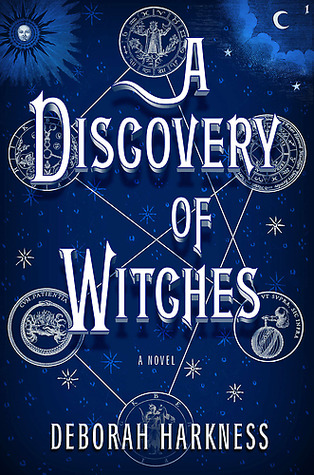
A Discovery of Witches by Deborah Harkness

A Discovery of Witches by Deborah Harkness

A richly inventive novel about a centuries-old vampire, a spellbound witch, and the mysterious manuscript that draws them together. 

Deep in the stacks of Oxford’s Bodleian Library, young scholar Diana Bishop unwittingly calls up a bewitched alchemical manuscript in the course of her research. Descended from an old and distinguished line of witches, Diana wants nothing to do with sorcery, so after a furtive glance and a few notes, she banishes the book to the stacks, but her discovery sets a fantastical underworld stirring, and a horde of daemons, witches, and vampires soon descends upon the library. Diana has stumbled upon a coveted treasure lost for centuries–and she’s the only creature who can break its spell.


“The most beautiful experience we can have is the mysterious. It is the fundamental emotion that stands at the cradle of true art and true science. Whoever does not know it and can no longer wonder, is as good as dead, and his eyes are dimmed (Albert Einstein)”


Daemons, Vampires, and Witches… Oh my!

I’m actually a little surprised that there are only these three types of supernatural creatures in this world, but hey. It is what it is.

We start off with a young scholar named Diana Bishop. I’m a little envious that she already has her doctorate and she doesn’t seem pretty old at all. Not to mention she’s spending her time in Oxford, one of the most amazing schools in the world. It seems like she’s just doing some regular research work on alchemy, probably working on her thesis or another book that she plans on publishing. Lo and behold, she just so happens to be a witch, and she was actually able to obtain a certain manuscript that has been deemed “missing” for almost a hundred years. And yet, she was able to get it.

That was one part of the story, and while the manuscript called “Ashmole 782” seems to be one of the most important plot devices, we still don’t fully know the extent of its importance. It probably has something to do with the origin of these species, maybe even the extinction or destruction of the species. It’s hard to know because when it was in the possession of Diana, she didn’t think to read through the entire thing or use her powers to figure out why some of the writing was moving and invisible.

Did I mention that Diana is a witch?

I ended up listening to this book in order to get through it. I don’t think I would have read it otherwise, with it being over 600 pages and it was mostly a way for me to pass the time during my commute. I won’t get much more into the book because there’s a potential for a lot of spoilers. I will say that I didn’t really like Diana as the main character. There were a lot of times where she was just really annoying and seemed way too ignorant for her age and for being a witch. Matthew, the vampire guy that she ends up falling for even though it seemed like he was going to attack her at some point, is alright too. Not my favorite vampire in the world, but at least he was worldly and knowledgeable. He also had a lot of doctorates as well, so clearly he was all about education and learning about the world he was imprisoned in for years on end.

I will probably read the second book solely because the first book ended before the coolest thing in the world could happen, which I knew it would because that’s how books like to be. I just want to know what happens next, and I’m curious to find out whether or not there may be other creatures out there, or what would happen if they were ever to mate with one another. I mean, it’s not normal that a witch and a vampire would fall in love and want to get together, so imagine the kind of chaos going on in this book about their love.

Rated: 3/5 

Wither by Lauren DeStefano

Wither by Lauren DeStefano

In the not-too-distant future, genetic engineering has turned every newborn into a ticking time bomb: Males die at age twenty-five, and females die at age twenty. While scientists seek a miracle antidote, young girls are routinely kidnapped and sold as polygamous brides to bear more children. When sixteen-year-old Rhine is taken, she enters a world of wealth and privilege that both entices and terrifies her. She has everything she ever wanted – except freedom.

Soon it becomes clear that not everyone at her new husband’s home is how they appear. With the help of Gabriel, a servant Rhine is growing dangerously attracted to, Rhine attempts to escape… before her time runs out.


“Tell freedom I said hello.”


I’m 25 years old. According to this book, I would have been dead five years ago.

I thought about that a lot when I was reading this book, especially because I think about where I was during my life five years ago. Would I have been happy to die at that age? Would I have felt like there was more out there for me and tried to fight for the chance to live and die the way I wanted to? That’s the amazing thing about dystopian books. It gives you a chance to imagine the world in a completely different way.

The book starts in complete darkness. Our main character Rhine is in a truck full of other girls, lost in the dark and they have no idea what’s in store for them. They were just taken from their homes and there’s no guarantee that they will ever go home. Rhine and two other girls – Cecily and Jenna – out of the entire group of girls in that van end up being whisked away to be the wives of a boy around their age, who just so happens to have a rich father. It’s there that Rhine has to learn that there’s a world out there that she isn’t used to, and not everything is as it seems.

In this world, cancer and every other human biological flaw have been “cured”, and the first generation of children to be born cancer and flaw-free grew up strong and healthy, with a lot of them still being alive today. However, it was their children and the children afterward where the problem was found. Every single generation after the first generation ends up dying at a young age. The males die at age 25, and the females die at age 20, no matter what. According to the first generation, there’s a virus that makes every single child a ticking time bomb. There are scientists out there that are working desperately to find a cure but to no avail. And yet there are other people that make it a point to do much worse things, from kidnapping girls from off the streets and selling them to be the baby-bearing brides to the rich.

Not all of these girls end up being wives though, not even sister wives like Rhine, Cecily, and Jenna became as the book progressed, and those that were not chosen could be found dead in the streets or disappeared entirely. When there was no chance of living past a certain age, it didn’t matter who ended up living or dying at an early age.

Rhine ends up having a very rare “birth defect” that just so happened to save her life. She has heterochromia, where one eye is brown and the other is blue. Everyone who meets her notices it, and they don’t always believe that they are actually real eyes. This is what ends up saving her from certain death, and it may also hold the key to the virus that kills everyone. At least, that’s what Rhine thinks when her captors basically tell her that her eyes are what makes her special and not as disposable as the others.

This book was interesting to me. To know that all of the children in the world are basically on a time limit is heartbreaking, and when factoring the fact that some of these children wind up murdered makes it even worse. Rhine basically had to lie to herself and to her husband Linden to make him think that she actually loved and cared for him when all she could think about was running away back to her twin brother. While she did end up learning how to care for him in the end – as well as Jenna and eventually Cecily – it didn’t take away from her main goal. It didn’t matter what it took, she wasn’t going to spend the rest of her life in this beautiful prison. It took her a while, but she ended up doing something about it, and that’s what matters.

Rated: 4/5 

The Falconer by Elizabeth May

The Falconer by Elizabeth May

“A riveting world, a fierce heroine, and electrifying action–I burned through this sparkling debut!” —Sarah J. Maas, New York Times bestselling author 

Edinburgh, 1844. Beautiful Aileana Kameron only looks the part of an aristocratic young lady. In fact, she’s spent the year since her mother died developing her ability to sense the presence of sìthichean, a faery race bent on slaughtering humans. She has a secret mission: to destroy the faery who murdered her mother. But when she learns she’s a Falconer, the last in a line of female warriors and the sole hope of preventing a powerful faery population from massacring all of humanity, her quest for revenge gets a whole lot more complicated. Now in paperback, this electrifying thriller—the first volume of a trilogy from an exciting new voice in young adult fantasy—blends romance and action with steampunk technology and Scottish lore in a deliciously addictive read.


“Crimson suits you best.”


I stumbled across this book at the library here in Virginia, and when I read the synopsis of it, I knew that I had to try it out. Lo and behold, it would end up being one of my favorite books this year.

For one thing, the steampunk aspect of this book, paired with 17th Century Scotland was something that I didn’t expect to work so well but it really did. Maybe the only thing that kind of messed me up was that I would keep forgetting that Aileana was Scottish until she’d say “Aye”. It was as if I was in an entirely new world filled with the infamous Fae creatures that I’ve come to learn and love – well some of them anyway – in an entirely new light that was nice to hear about.

Let me start off by saying that I personally liked Aileana. Yes, she’s actually a proper Lady, with money, status, and a title that not all women can say they have. If she were to get married, her husband would probably inherit a lot of wealth and prestige. However, ever since her mother was murdered right in front of her eyes, she had no desire to be a part of that world anymore. She had vengeance in her heart, almost to the point of hatred, and all she wanted to do was find the Fae that killed her mother and exact her revenge. In the meantime, she did what she could: taking care of the other dangerous Fae around Edinburgh so that the human casualty rate wasn’t ridiculously high.

But how did she go from a lady that only cared about society’s parties, to someone that would spend her days inventing new weapons and her nights slaying the Fae?

She had a mysterious teacher, one that wasn’t all that human himself. She spent an entire year training with him, a Fae named Kiaran, one of the most powerful breeds of Fae in existence. But what she didn’t know was that there was something far worse at stake, and all of her nights that she spent fighting alone behind Kiaran’s back would make her a target, and the real fight would begin. She would have to put aside her revenge plans and figure out how a barely trained Falconer, a breed of warrior woman that have the power to kill the Fae, would be able to save the world on her own.

Aileana was an interesting protagonist. She had no problem letting us know that she was in pain, and having the memory of her mother killed right in front of her eyes was something that she couldn’t let go of so easily. Anything that even resembled her mother would bring her back to that night, and it would fill her with such a rage that it was almost dangerous to be around her. She knew that, and she tried to suppress it as much as she could around Kiaran so that he wouldn’t know her weakness. It was something that despite all of her efforts, she just could not let it go. She felt like it was her fault that her mother was murdered because she didn’t do anything to stop it. It led her to go out the next night and immediately try to kill a different Fae, and while she almost died, it was a good thing that Kiaran found her. She was thoroughly untrained that first night she tried to fight, and even though she knew it, she still wanted to satisfy the lust for death in her heart. The more she would kill, the happier she felt, even if it was just in that moment when the light would leave her victim’s eyes.

I also liked the fact that she is an inventor. She created her very own flying machine, even though it seems like many of the rich families have at least one of their own. She designed and created her own, with a bat as the inspiration for its wings. She created all of the weapons she would use against the Fae. It was something that she would do with her mother, and even though her mother was gone, she kept up this important hobby that would become useful to her in her future battles. All in all, I liked her personality and her ingenuity.

One of the things that confused me though was how sometimes the chapters would jump through time. One chapter would end with a certain event going on and the next chapter would start off hours or even half a day later. It made me feel like I was missing something, or that I needed to go back and make sure that I didn’t skip a page or something like that. I understand that not all chapters have to take place back to back but it still left me confused. The ending as well was one that I didn’t understand. It ended up abruptly that I had to go back and see what happened, and yet I still didn’t quite get it. Something definitely happened, but hopefully the next book will be able to explain it better than this first one did.

Rated: 4/5